Cernavodă
Ancient Axiopolis, Saligny's bridge and Romania's energy.
Back to the Dobruja pageAbout the town
Cernavodă, in brief
Cernavodă has guarded the Danube crossing towards Dobrogea for millennia. Here, on the hills above the river, stood the ancient fortress of Axiopolis, and in the nearby floodplain the famous statuette "The Thinker of Hamangia" was discovered, one of the best-known pieces of Neolithic art in the world.
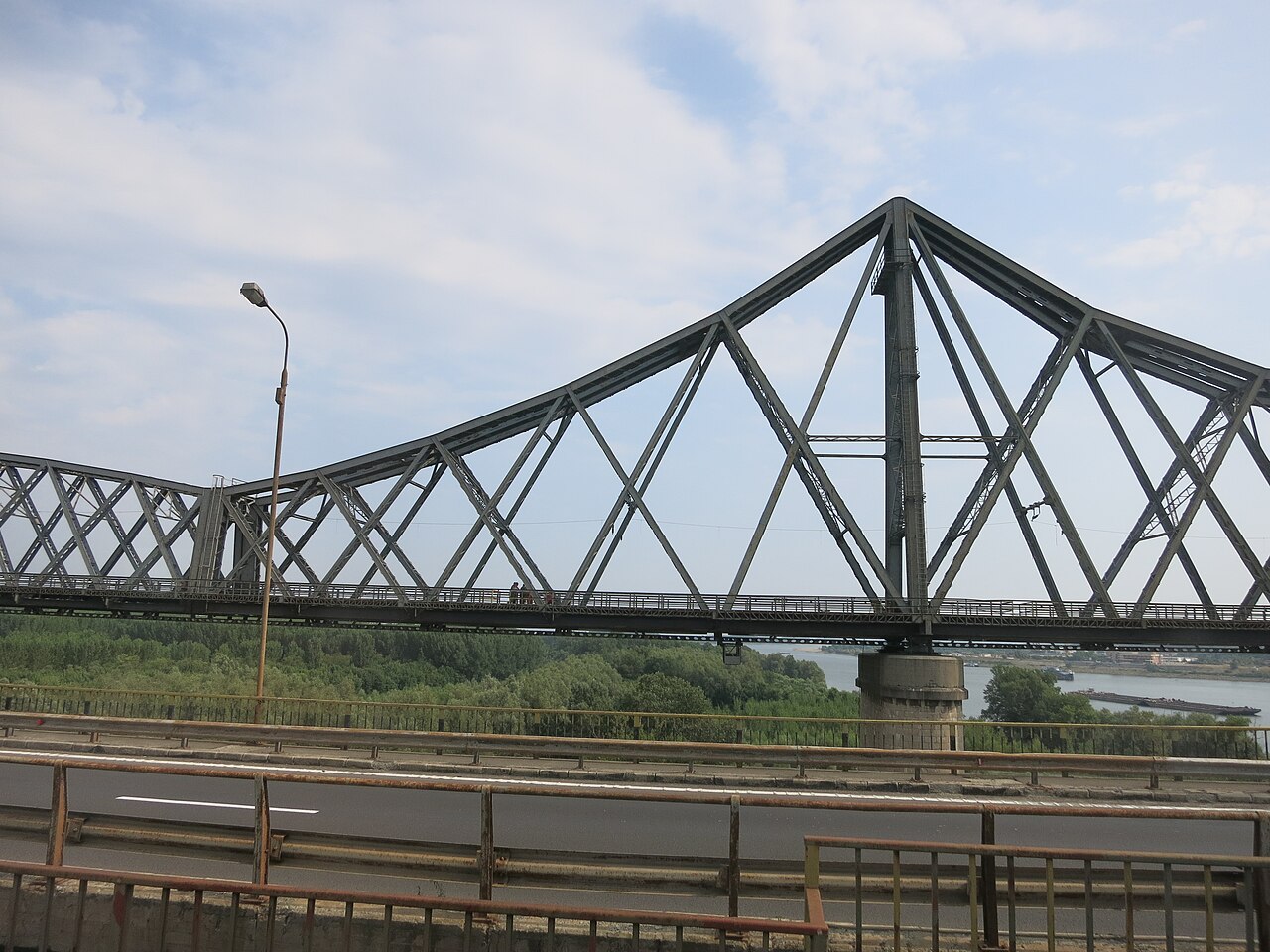
In 1895, engineer Anghel Saligny inaugurated the railway bridge over the Danube here, at the time the longest in Europe, an engineering masterpiece that linked Dobrogea to the rest of Romania. The bridge still stands today, proof that things well calculated endure.
Today's Cernavodă is the city of energy: the nuclear power plant produces roughly one fifth of Romania's electricity, and the Danube–Black Sea Canal begins right here.
History
Cernavodă through time
The moments that shaped the town, from the first settlements to today.
Hamangia culture
The Neolithic Hamangia culture flourishes in the area; "The Thinker" and "The Seated Woman" are discovered here.
Axiopolis
The fortress of Axiopolis controls the Danube crossing; it will be strengthened by Romans and Byzantines.
First railway
The Cernavodă–Constanța line, the first railway in Dobrogea, starts from the port.
Anghel Saligny Bridge
The railway bridge over the Danube is inaugurated, the longest in Europe at the time.
Nuclear power plant
The first reactor at Cernavodă goes into operation; the second follows in 2007.
To see
What to see in Cernavodă
Anghel Saligny Bridge
Engineering monument from 1895, visible from the new A2 motorway road bridge.
With its 4,088 m, the ensemble of bridges and viaducts designed by Anghel Saligny was at inauguration the longest in Europe. The Romanian engineer used soft steel and cantilever girders for the first time, and for the load test he stood beneath the bridge with his team while a train of locomotives passed overhead.
Work begins, after foreign designs had been rejected.
Inauguration with a train of locomotives at speed; the bridge passes the test.
The new railway bridge takes over traffic; the old bridge becomes a monument.
Axiopolis site
Remains of the ancient fortress on Sofia Hill, above the Danube.
Founded in the Hellenistic era and rebuilt by Romans and Byzantines, Axiopolis guarded the Danube crossing for nearly a millennium. On Sofia Hill the ramparts and traces of walls can still be seen, with the Danube flowing at their feet.
The fortress is founded on the heights above the crossing.
The Byzantines rebuild it; it remains a strategic point on the limes.
Archaeological site with visible ramparts.
Cernavodă Lock
Kilometre zero of the Danube–Black Sea Canal.
Here, at kilometre zero of the canal, vessels descend or ascend between the level of the Danube and that of the canal through twin 310 m locks. The sight of ships "climbing the water stairs" is worth a stop.
Construction of the present canal section begins.
The lock enters service together with the canal's inauguration.
Transit point for thousands of vessels annually.
From the database
Places around Cernavodă
Map
Landmarks on the map
Pins open the place sheets for Cernavodă.
Explore the region
Other towns in Dobruja
Corector de sat
Dacă știi că un fapt de pe pagina asta e greșit, scrie-l. Redacția publică doar după verificare. Nu e chat.
Software rooted in these places
From the region of Cernavodă we build four free apps: iShopSync, Gym, iMemory and Daunomania.
See our apps